
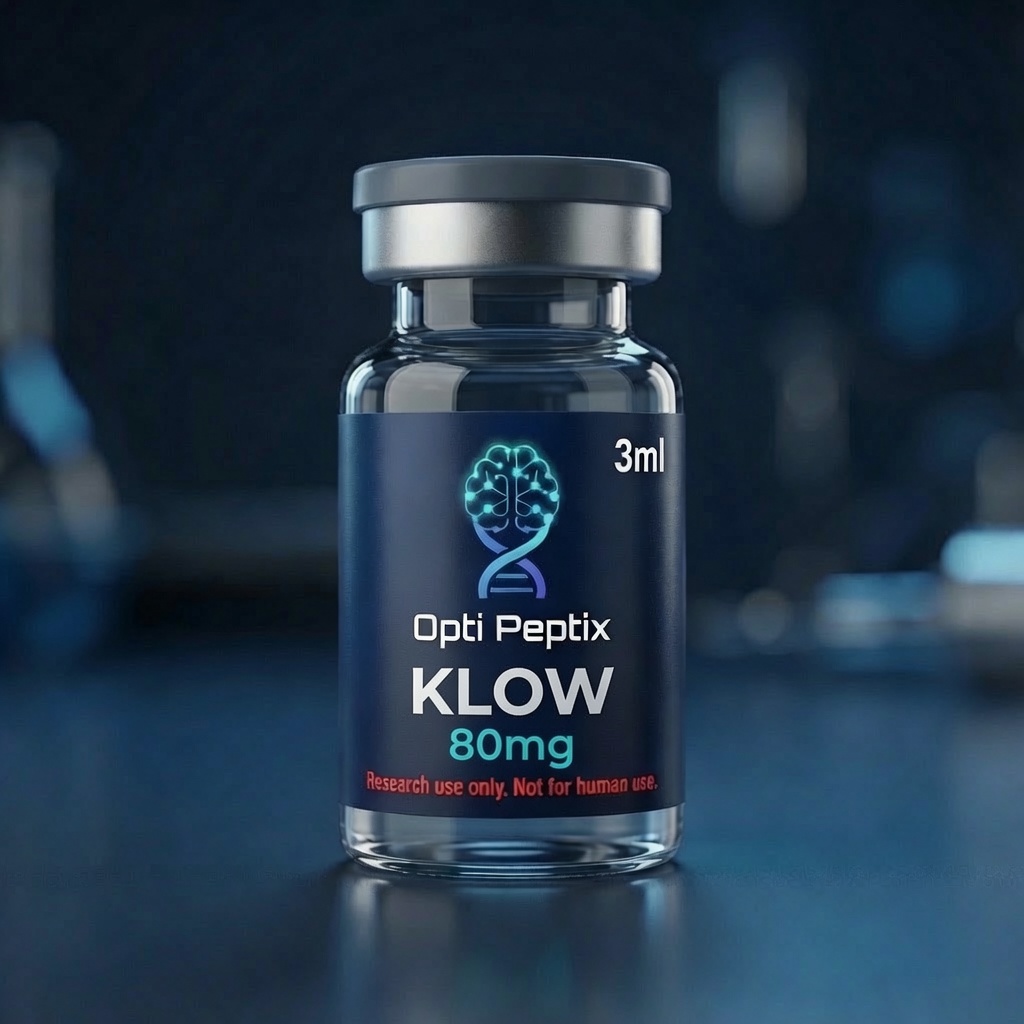
KLOW is a research blend (typically GHK-Cu ~50mg, BPC-157 ~10mg, TB-500 ~10mg, KPV ~10mg per vial) investigated in preclinical and limited clinical contexts for potential synergistic effects on tissue repair, inflammation modulation, and regeneration. No dedicated large-scale RCTs exist for the specific KLOW combination; evidence derives from individual peptide studies and vendor/researcher hypotheses on multi-pathway support.
Potential Mechanisms of Action (Synergistic “How It Helps”)
The blend targets overlapping biological pathways:
- Tissue Repair & Regeneration: BPC-157 and TB-500 promote angiogenesis, cell migration, fibroblast activity, and cytoskeletal remodeling. GHK-Cu supports extracellular matrix (ECM) remodeling, collagen/elastin synthesis, and stem cell-like behaviors.
- Anti-Inflammatory Effects: KPV inhibits NF-κB signaling and reduces pro-inflammatory cytokines (e.g., TNF-α, IL-6). Complementary actions from BPC-157 (modulates NO/MPO) and GHK-Cu (antioxidant, STAT3/SIRT1 pathways) may help resolve inflammation without broad immunosuppression.
- Wound Healing & Barrier Support: Combined promotion of re-epithelialization, vascularization, reduced fibrosis/scarring, and mucosal integrity (gut/skin).
In research models, such stacks are explored for accelerated recovery from mechanical/ischemic injury, inflammatory challenges, or barrier disruption.
Research Contexts and Potential Applications (“Who/What It Might Help” in Studies)
Evidence is primarily preclinical (rodent/cell models) with early human data for components. Potential research areas include:
- Musculoskeletal Injuries & Post-Surgical Recovery: BPC-157 and TB-500 studied in tendon, ligament, muscle, and bone models for faster healing. A Phase 2 trial is evaluating BPC-157 for acute hamstring strains. TB-500 (Thymosin β4 fragment) explored for soft tissue repair.
- Wound Healing & Skin Regeneration: GHK-Cu has clinical data from topical use showing improved collagen, reduced wrinkles, and faster closure in photoaged skin or ulcers. TB-500 in Phase 2 for venous stasis ulcers/dry eye. Combinations hypothesized for broader dermal/systemic support.
- Inflammatory & Gut Conditions: KPV and BPC-157 show promise in colitis/IBD models for mucosal healing and cytokine reduction. Related K(D)PT had Phase 2 signals in ulcerative colitis.
- Chronic Inflammation, Autoimmune Models, or Systemic Recovery: The blend’s anti-inflammatory + regenerative profile is researched for conditions involving persistent inflammation, oxidative stress, or impaired healing (e.g., post-trauma, metabolic stress).
- Anti-Aging & Cellular Renewal Research: GHK-Cu levels decline with age; studies link it to gene regulation for ECM and antioxidant effects. Overall stack explored for skin firmness, energy/resilience markers in wellness models.
Evidence Level Summary:
- Strongest for individual components in animal wound/tissue models and some human topical/safety studies.
- Limited high-quality human RCTs for systemic/injectable use or the blend itself. Benefits remain investigational.
Safety Note (General Research Context): Preclinical data suggest favorable profiles with low toxicity, but human data are sparse. Theoretical risks (e.g., angiogenesis in certain contexts) warrant caution. These are RUO compounds—not approved for human use. Consult primary literature, regulatory sources (e.g., FDA, clinicaltrials.gov), and qualified professionals for any research applications.
Individual Peptide Components and Scientific Background
1. BPC-157 (Body Protection Compound-157)
- Structure: Synthetic pentadecapeptide (15 amino acids) derived from a protective protein found in human gastric juice. It is stable in gastric acid.
- Mechanisms: Promotes angiogenesis (via VEGFR2-Akt-eNOS pathways), modulates nitric oxide, upregulates growth hormone receptors in tendons/fibroblasts, reduces inflammatory mediators (e.g., MPO, LTB4), supports cytoprotection, and aids tissue remodeling. It shows pleiotropic effects in preclinical models of muscle, tendon, ligament, gut, and organ repair.
- Research/Trials:
- Extensive preclinical (rat/mouse) data on accelerated healing in trauma, ischemia, and inflammatory models.
- Limited human evidence: Phase I safety/PK trial (NCT02637284) for oral PCO-02 (BPC-157) in healthy volunteers. Ongoing or recent Phase 2 for acute hamstring strain (NCT07437547).
- Small uncontrolled case series (e.g., knee pain injections, interstitial cystitis) reported subjective improvements, but lack controls and rigor.
- Narrative reviews note encouraging but limited high-quality human data; no major toxicity signals in available studies.
2. TB-500 (Thymosin Beta-4 fragment, often the 17-23 actin-binding sequence LKKTETQ)
- Structure: Synthetic fragment of the naturally occurring 43-amino acid Thymosin Beta-4 (Tβ4), which sequesters G-actin.
- Mechanisms: Binds G-actin to regulate polymerization/depolymerization, promoting cell migration, cytoskeletal remodeling, angiogenesis, stem/progenitor cell mobilization, reduced myofibroblast formation (less scarring), and anti-inflammatory/antifibrotic effects. Supports wound healing and tissue regeneration.
- Research/Trials:
- Strong preclinical data in wound, corneal, and cardiac models.
- Human trials on full Tβ4 or related: Phase 1/2 safety in cardiovascular contexts; topical for venous stasis ulcers and dry eye (improved symptoms in some studies); pilot data in heart attack patients.
- TB-500 itself has fewer direct human efficacy trials; safety appears favorable in available Phase 1 data.
3. GHK-Cu (Glycyl-L-histidyl-L-lysine copper complex)
- Structure: Naturally occurring tripeptide that strongly binds Cu²⁺; levels decline with age.
- Mechanisms: Copper delivery (redox-silenced for safe transport), gene regulation (affects thousands of genes related to ECM remodeling, collagen/glycosaminoglycan synthesis, antioxidant enzymes, anti-inflammation), promotes fibroblast activity, wound contraction, angiogenesis, nerve regeneration, and stemness. Antioxidant and anti-inflammatory via pathways like SIRT1/STAT3 in some models.
- Research/Trials:
- Extensive in vitro, ex vivo, and animal data on skin repair, wound healing, and anti-aging.
- Human clinical: Placebo-controlled studies on topical creams showed improved skin elasticity, collagen production, wrinkle reduction, and photoaging signs in women. Preclinical promise in colitis models.
- Well-tolerated in dermatological applications; supports tissue remodeling without major safety issues reported.
4. KPV (Lys-Pro-Val)
- Structure: Tripeptide fragment from the C-terminal of α-melanocyte-stimulating hormone (α-MSH).
- Mechanisms: Potent anti-inflammatory via PepT1-mediated uptake into cells (especially intestinal/immune), direct nuclear effects inhibiting NF-κB (blocks p65RelA translocation), reduced pro-inflammatory cytokines (TNF-α, IL-6, IL-8, etc.), and modulation of immune responses without broad immunosuppression or melanocortin receptor pigmentation effects. Supports gut barrier integrity and mucosal healing.
- Research/Trials:
- Preclinical (cell culture, rodent colitis/Crohn’s models): Reduced inflammation, weight loss, histological damage, and cytokine levels.
- Limited human data; related K(D)PT tripeptide showed promise in a Phase 2 UC trial (safety and efficacy signals). Delivery enhancements (e.g., iontophoresis, microneedles) studied for transdermal use.
- Generally favorable safety profile in models; no large-scale human trials for the standalone tripeptide.
Potential Synergies in KLOW and Research Context
The blend is designed to target overlapping pathways: inflammation control (KPV + others), matrix remodeling/collagen (GHK-Cu), cell migration/angiogenesis (TB-500 + BPC-157), and broad cytoprotection/tissue repair. Vendors cite interest in multi-peptide signaling, fibrosis reduction, and recovery models, but this remains hypothetical without direct blend trials.
Overall Evidence Level: Predominantly preclinical for most components, with varying degrees of early human data (safety-focused or small/uncontrolled). Larger, rigorous RCTs are needed. Concerns (e.g., theoretical angiogenesis-related risks with BPC-157) exist but lack strong clinical substantiation.
All information is for general scientific context. These are RUO compounds; consult primary literature and regulatory sources for details.